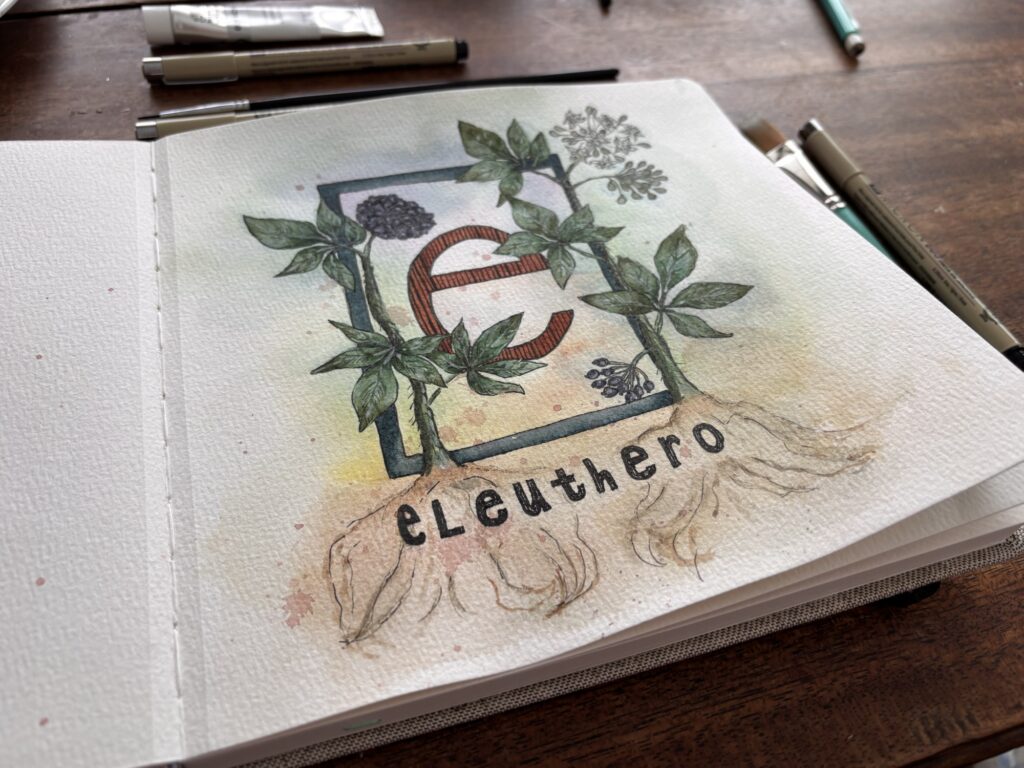
Eleuthero. If Ashwagandha is a gentle hug, then Eleuthero provides a sort of tenacity for endurance. Eleuthero, or Eleutherococcus senticosus, is about restoration. A refresh. This herb is an adaptogen. Adaptogens are herbs that give the body the ability to adapt to stress. Adapting means that it helps the body systems stay regulated under pressure.
Eleuthero & The Doshas
Eleuthero is an herb mostly used by the Chinese and the Russians. In fact, in the 1940’s, the Russians discovered that Eleuthero gave soldiers stamina in difficult conditions. Eleuthero brings tenacity to the body. There is an ability to fight in immense pressure. But Ayurveda, which originated in India, has used Eleuthero, too. In Ayurveda, there are three main “Doshas”. Each person has all three doshas. But most people are made up of two dominant doshas while the third is the least dominant. For more infomation about doshas, be sure to read my blog post The Herbalist’s Steps.
Eleuthero & Vata Dosha
Eleuthero helps the Vata Dosha the most. The Vata Dosha has a tendency to run from stress. They also tend to be chatty and can think fast on their feet. Their flexibility can be their strength or weakness. Too much flexibility in life means no boundaries. No stability. Eleuthero helps the Vata Dosha stay grounded. It helps the Vata to face the stress without feeling like they’ll float away.
Eleuthero & Kapha Dosha
Eleuthero also can help the Kapha Dosha. The Kapha Dosha tends to be slow. They are stable and content. Out of all three doshas, they are the most compassionate and kind. Kat Maier, in her book Energetic Herbalism, mentions that Kapha is another word for mucus. That doesn’t sound pleasant, but stick with me. Kapha Doshas have good joints and digestion because of this mucus; but this mucus can also build up and become their weakness. Eleuthero warms the body. Warming herbs create circulation and movement which can help Kapha by ridding it of the excess of mucus.
Eleuthero & Pitta Dosha
The Pitta Dosha is hot with fire and a bit of water. The Pitta Dosha doesn’t generally need Eleuthero. In fact, Eleuthero could overheat the fire in Pitta and cause imbalance. But if Pitta becomes too relaxed and in a state where it cannot hold water, Eleuthero could bring strength and tone the tissues. Overall, Pitta Doshas should be cautious and consult a skilled herbalist before taking Eleuthero.
Eleuthero & the Body Systems
Eleuthero is an adaptogen which means that it gives the body tools to help it adapt to stress. Since it is an adaptogen that helps the body with stress, that means it’s good for the nervous system. It brings calm, but also provides stamina and endurance in severe conditions. Eleuthero also helps the immune system, specifically the spleen. It has properties that normalize hyper and hypo immune systems. Since Eleuthero is a warming herb, it increases circulation which can be good for the cardiovascular system.
Eleuthero builds. Strengthens tissues in the body, including tissues in the Urinary System. In Chinese medicine, Eleuthero is said to help the kidneys. Some have used Eleuthero for adrenal support, estrogen dominance, and chemo side effects. Eleuthero gives the body stamina to fight in battle, whether it’s a battle to stay focused, or an actual physical battle.
Herbal Actions
Eleuthero’s actions on the body include:
- Adaptogenic
- Hypotensive
- Immune Amphoretic (The Modern Herbal Dispensary This book is an incredible resource!)
- Nervine
- Anti-Inflammatory
Herbal Energetics
Eleuthero’s Taste & Energetics
Pungent: The pungent or spicy taste makes movement in the body. Spicy foods help the digestive system, and they also warm the body.
Slightly Bitter: The bitter taste calms, cools, and eliminates. It also dries out. Slow digestion can improve when you eat or drink bitters because it produces enzymes in your body to help break down food. Gaia explains that because of the bitter taste, Eleuthero root is taken as a tonic. Have you ever heard of Digestive Bitters? Eleuthero works a bit like a digestive bitter (but it isn’t considered a digestive bitter-remember, first, it’s an adaptogen). But the slight bitterness in eleuthero will create some sort (each person is different) of digestive reaction in the body.
Eleuthero & the Tissue States
Remember the six tissue states? They are heat(excited/hyper state), cold(depressed), damp stagnant(stuck/torpid), dry(atrophic), wind (constricted/tense), damp flow(relaxed). From looking at all my research into Eleuthero and how it helps the body, I would recommend it for the cold/depressed state and the Damp Flow/Relaxed State. I recommend it for the depressed state because it warms the body. Not only does it warm the body, it also helps to increase circulation. It gets your blood moving. I recommend it for the relaxed state because it tones and builds.
More About Eleuthero
Eleuthero, or Siberian Ginseng (but it isn’t officially in the ginseng family, which is a bit tricky), is a plant that grows mostly in Asia. Most of time, the roots are used. But only after the root bark is removed. Sometimes the leaves and stems are used. There are some herbalists or natural doctors who recommend using Eleuthero for estrogen dominant conditions like endometriosis. Others use it for symptoms related to menopause. And the Chinese use Eleuthero as a way to live longer. This may have something to do with how it helps with stress and endurance.
Conclusion
Whew. So, writing this post about eluthero was exhausting. It made me realize how much learning I have ahead of me as a beginning herbalism student. I’m reminded often of how much I don’t know. (sigh). There are a lot of plants out there, a lot of diseases to understand…whew! And I’m just getting started.
As always, please consult a doctor or experienced herbalist before consuming any herbs. I did not mention any possible side effects while using Eleuthero, but that doesn’t mean there isn’t any. Each person’s make up is different, you never know how you’ll react to an herb. Please, just ask your doctor.
And also, I’m super thankful for all the herbalists before me who have written down what they know and teach what they’ve experienced with herbs. The more I get to know each herb, the more I realize how much learning has been passed down to others. It’s humbling. I couldn’t learn without them.
So, if you have a minute, let me know if you’ve ever used Eleuthero. Or maybe share something you love about herbalism. I’d love to hear from you.